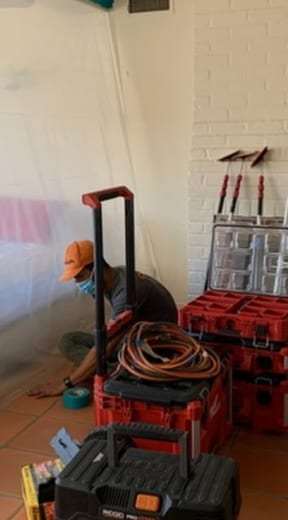
Technician setting up tools inside plastic containment. Example of the work involved; the photo does not show a specific property or a job for this site.
Separating outdoor air from indoor sources
Communities near an airport sometimes receive resident comments about outdoor odors. Whether any given complaint relates to outdoor air depends on many factors, and these notes make no claim about conditions at any location. The aim here is to give staff a way to sort complaints.
The most useful first step is the closed-window test. If the smell goes away when windows and doors are closed, it is more likely to be entering from outside. If it stays, then something inside the unit or building is the more likely source and a normal inspection applies.
Where a complaint does appear to involve outdoor air, there is usually little maintenance can do except explain, suggest closing windows at particular times and check that door sweeps and window seals are in good order. Record the complaint anyway. If reports cluster by time or wind direction, the pattern may be worth discussing with management.
Do not tell residents that an outdoor source is responsible without checking the unit first. A confident wrong answer damages trust more than taking a few minutes to look.
Keep the language with residents simple and neutral. Saying that the smell will be checked, and then reporting back with what was found, is more useful than debating its origin, and it keeps the record accurate for later review.
Quick sorting checklist
- Ask when the smell occurs and what the weather was like.
- Try the closed-window test.
- Inspect door sweeps, window seals and weatherstripping.
- Check the unit for indoor sources: drains, filter, trash, closets.
- Log the complaint and its conditions.
Observation and next step
- Observation
- Smell only with windows open
- Possible meaning
- Outdoor air entering
- Next step
- Advise on airing times; check seals
- Observation
- Smell with windows closed
- Possible meaning
- Indoor source
- Next step
- Inspect unit and systems
- Observation
- Smell varies with wind
- Possible meaning
- Outdoor influence
- Next step
- Log by date and conditions
- Observation
- Smell constant and local to a room
- Possible meaning
- Indoor source
- Next step
- Inspect that room and its vents
Common questions
How can staff tell whether a smell comes from outside?
Close the windows and run the unit's fan on recirculate for an hour. If the smell fades, outdoor air is likely; if it stays, look for an indoor source such as drains, trash or the HVAC filter.
How should staff talk with a resident about outdoor air?
Acknowledge the report, explain that the unit will be checked, and share what was found. Avoid naming an outside cause unless the checks support it.
Why log complaints that seem outdoor-related?
Entries with dates, weather and wind notes can show whether reports cluster at certain times, which gives management something factual to review.
Can seals and sweeps make a difference?
Sometimes. Worn door sweeps and window seals let outside air in more easily, so replacing them is a low-cost check that also helps comfort generally.
General information for Centennial, not a quote or professional advice. In an emergency, call 911.